


Lars Staffan Evjen
Silence Afterwards
11.9.–15.11.2026
(Click here for Norwegian text)
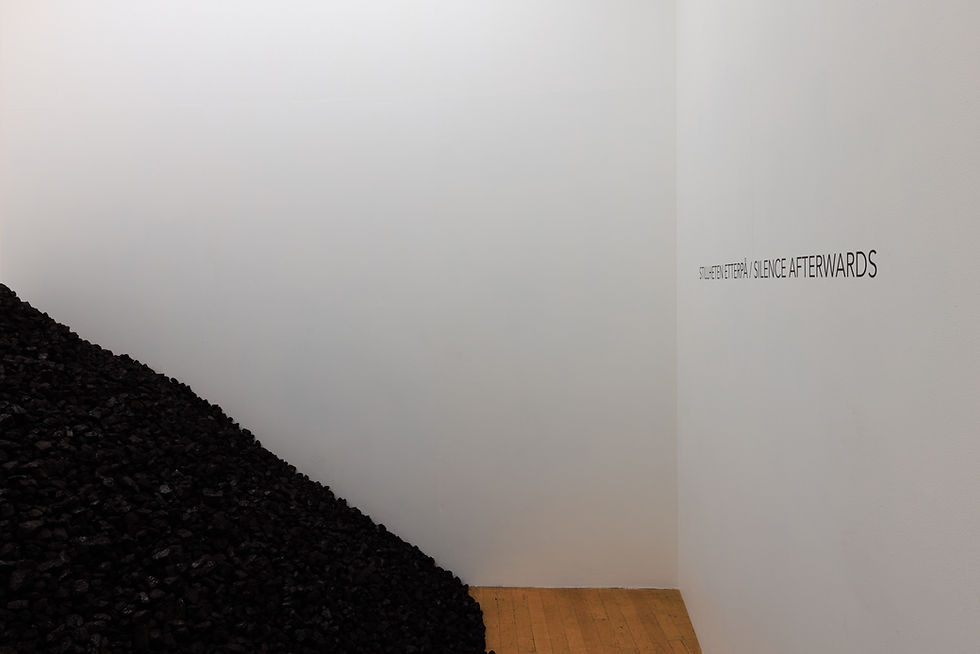
The installation Silence Afterwards by Lars Staffan Evjen holds a moment open.
Black coal has spilled down and across the white space, as if a fall has come to rest. The extent of the mass suggests a movement that is no longer taking place; what might once have been a dramatic event has been reduced to a silent trace. The room appears to exist in a state of suspension – between the event and its consequence. It is as though time itself has been displaced: we arrive at the moment when something has already happened, but where the meaning of what has happened has not yet been determined.
Coal has a particular ability to make time tangible. The material carries with it a depth of time that exceeds human imagination. It is formed from former life, organic matter transformed through geological processes of pressure and heat. Within the black material, a distant biological past meets our own industrial present.
Coal is at the same time one of modernity’s most potent materials. Extracted from the depths of the earth, it has been transformed into energy, heat, production and movement – one of the fundamental conditions of industrial civilisation’s acceleration. It is difficult to imagine modernity without this energy. In the work, that same energy has been left still.
A displacement therefore takes place. The material is released from its function and appears as something else: as geological memory, as residue, as sediment. The industrial and the organic can no longer be kept apart. Coal exists simultaneously in several times.
Variations of the installation have previously been shown by Evjen at different institutions, under the title Untitled. The difference between the two titles is interesting in itself. Untitled leaves the material without a particular interpretive framework. Silence Afterwards, by contrast, opens onto an idea of time: something has happened, something has come to a halt, and we may find ourselves in what comes after. The title is borrowed from Rolf Jacobsen’s poetry collection of the same name. Here at Kunsthall 3,14, the work is installed alongside Simone Hooymans’ exhibition The Perpetual Tapestry. The juxtaposition with Hooymans’ work may also contribute to shifting how we encounter Evjen’s installation. In encountering both works, we may find ourselves in a time we cannot fully comprehend, between what has happened and what may yet come.
Here, “afterwards” can also be read as something more than a literary image. It becomes a spatial experience. We are already there, in the afterwards.
The question is therefore not only what has happened, but what such an “afterwards” might entail. What happens to our understanding of time when a material from a distant geological past lies before us as the residue of a relatively brief, but violent, human history?
Coal connects us to a world before humanity, while at the same time being inseparably bound to the world we have built. What was once alive has become energy. Energy became industry. Industry set the world in motion. And now the material remains as a dark sediment in a white room.
Here, the idea of homelessness also emerges as a possible underlying motif. In this context, homelessness is not about lacking a physical place to live, but can be understood as the experience of having lost our connection to that of which we ourselves are a part: the earth, nature’s different scales of time, other living beings, and the larger systems that existed before humanity made itself the measure of the world.
Perhaps homelessness here is also about having lost the feeling of belonging to time. Humanity has become a force that changes the world at a pace that stands in stark contrast to the geological processes that have shaped the material before us. We live in a time we ourselves have set in motion, while at the same time remaining dependent on systems and connections we did not create.
Humanity arrived late in the history of the earth. We are a brief episode within a much larger biological and geological story. But “late” can also mean that we are only now beginning to understand how late it actually is. We recognise connections after having broken them. We understand our dependence on nature at the same time as we attempt to make ourselves independent of it.
There is a movement here that points forward – preoccupied with endless growth – while simultaneously making us aware of where we come from. Is there a persistent unease within this movement? Not necessarily a rejection of technology, but a suspicion towards the idea that development is always synonymous with progress. The modern world is organised around speed, production and transcendence. Everything seems directed towards what comes next.
The work can turn our perspective around. It holds us in the moment afterwards. Here, silence is not merely the absence of sound, but a counterweight to acceleration. A temporary suspension of systems of production and consumption. A space in which the material no longer has to serve a function, but can simply be present.
What will remain afterwards? The question points backwards towards what has already happened, but also forwards towards a time we do not yet know. It is a question of consequence, but also of what remains when movement has come to a halt. Between these two directions, the installation’s central tension emerges.
Coal lies there as the past, but also as a possible future. As energy and residue, as nature and culture, as movement and stillness.
Silence Afterwards allows us to remain within this interval – in a space where a collapse has come to a halt, where time seems to have taken material form, and where “afterwards” has not yet decided what it will mean.
Lars Staffan Evjen (b. 1945) is a Norwegian artist whose practice focuses primarily on drawing and installation. Selected solo exhibitions include Samisk kunstnersenter, Kunstmuseet KUBE, Bomuldsfabriken Kunsthall, and Bergen Kunsthall. His work has also been included in major group and collective exhibitions, including Bergen Open 1 at KODE, Nordic Drawings, and Greyscale/CMYK. Evjen’s works are held in major collections including The National Museum, KODE, Kunstmuseet KUBE, and Northern Norwegian Art Museum.