
Shwan Dler Qaradaki
5.6.– 30.8.2026
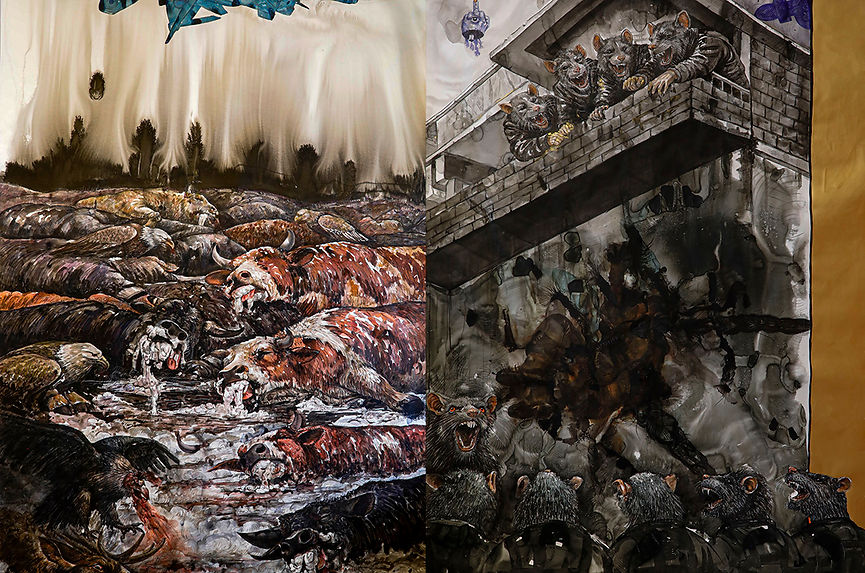
The exhibition presents the new series From Above of watercolor drawings alongside works from the series Halo of Shame, bringing together interconnected reflections on violence, language, exile, and collective memory. In the new works, metallic birds cross the sky above landscapes that appear both silent and devastated. Beneath them lie fragmented terrains, stacked bodies, and traces of collapse. The drawings examine forms of vertical power in which violence is exercised from a distance through military and technological systems. From above, destruction becomes abstract, while the ground below turns into an archive of human vulnerability and historical devastation. The works reflect on how war and violence repeat across time, leaving lasting traces in both landscapes and collective consciousness.
At the same time, the drawings contain gestures of resistance and survival. Groups of women appear in quiet solidarity beneath skies where religious and military symbols occupy the same space. Here, language, poetry, and storytelling emerge as counterforces to systems that seek to control bodies, history, and narrative. Through a visual language that moves between figuration and symbolism, the works explore how experiences of war and displacement can speak more broadly about power, fragility, and human endurance.
These new works can be understood as a continuation of Halo of Shame, an earlier multidisciplinary project investigating language loss, cultural suppression, and identity through drawing, watercolor, video, text, and sound. While the new series expands toward broader reflections on violence and historical continuity, Halo of Shame originated in the historical marginalization of Kurdish language and culture. At its core is a series of large-scale watercolor drawings inspired by the letters of the Kurdish alphabet, functioning as metaphorical traces of a language and culture subjected to fragmentation and erasure.
Across both series, a hybrid visual language emerges in which elements from Western art history intersect with Islamic miniature traditions and Kurdish symbolism. Motifs such as snakes, doves, landscapes, and apples — associated with the chemical attacks against Kurds in the late 1980s — carry both personal memories and collective trauma. Together, the works explore how art can function as an alternative language: a space where histories, memories, and experiences can be preserved and transformed when conventional forms of language prove insufficient.